The historic INS Dunagiri Sanshodhak Agray Commissioning ceremony will see the Indian Navy integrate three frontline naval platforms simultaneously. In a landmark event for India’s maritime defence, Prime Minister Narendra Modi is scheduled to commission three indigenously built frontline naval platforms INS Dunagiri, INS Sanshodhak, and INS Agray in Kolkata on 21 June 2026. This rare triple commissioning, only the second such event in recent years after Mumbai’s January 2025 ceremony, signals India’s accelerating push toward Aatmanirbhar Bharat in the naval shipbuilding domain.
All three vessels were designed by the Indian Navy’s Warship Design Bureau and constructed by Garden Reach Shipbuilders & Engineers (GRSE), Kolkata. They were delivered to the Navy on 30 March 2026 a historic first for GRSE, which delivered three major naval platforms simultaneously. With indigenous content exceeding 75% across all three ships and over 200 MSMEs involved, this event is a powerful statement of India’s self-reliant defence manufacturing ecosystem.
Commissioning date in Kolkata, presided over by Hon’ble Prime Minister Narendra Modi a rare triple commissioning event.
Builder: Garden Reach Shipbuilders & Engineers. First-ever simultaneous delivery of three major naval platforms by GRSE on 30 March 2026.
Indigenous content across all three vessels. Over 200 MSMEs participated, generating ~4,000 direct and 10,000+ indirect jobs.
Dunagiri (P17A stealth frigate), Sanshodhak (Survey Vessel Large), Agray (Arnala-class ASW craft) combat, survey, ASW.
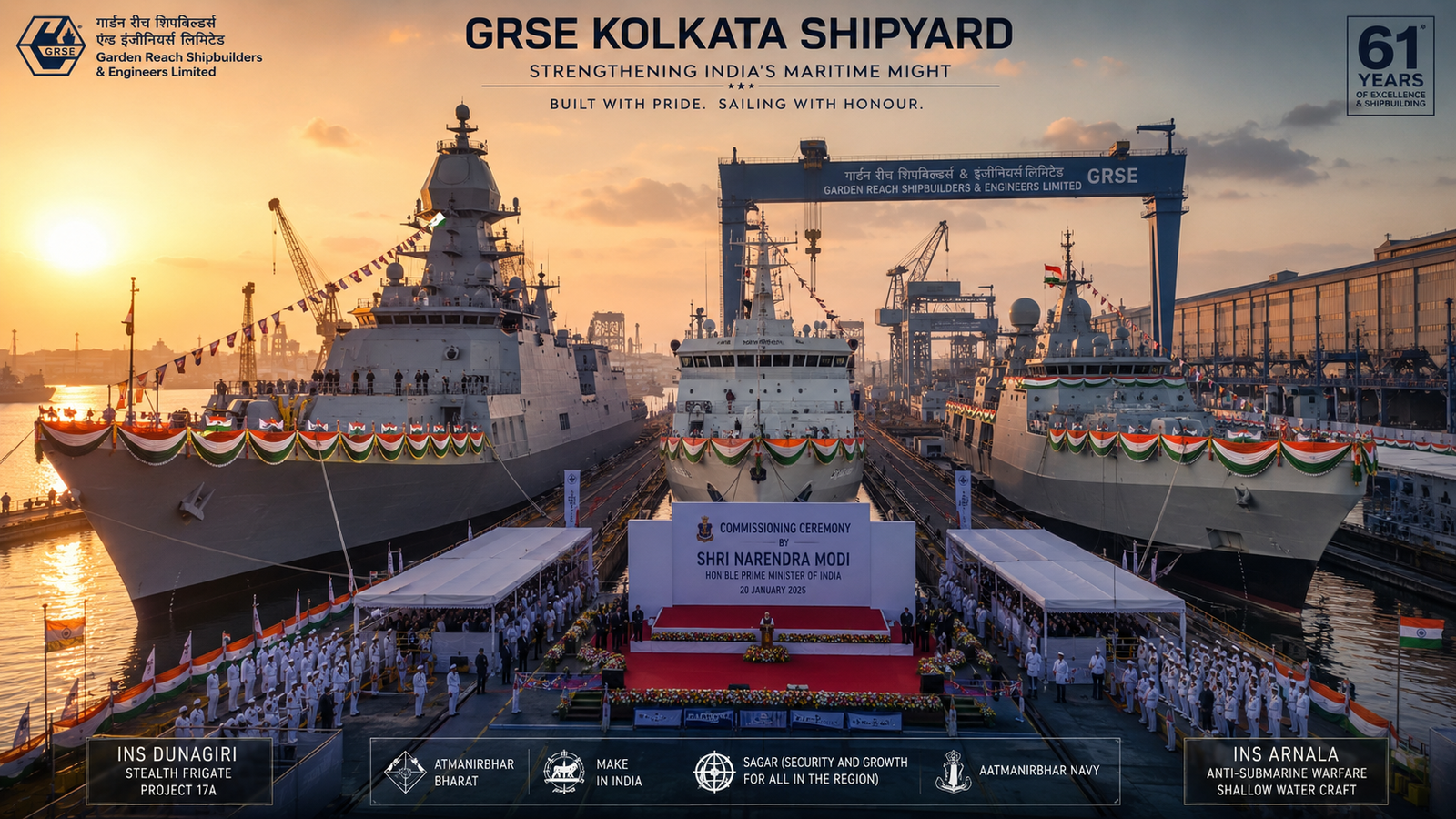
The simultaneous operation of the INS Dunagiri Sanshodhak Agray Commissioning is not routine fleet expansion it is a strategic force multiplier for the Indian Navy. In one ceremony, India adds a stealth-guided missile frigate, a deep-water hydrographic survey vessel, and an anti-submarine warfare shallow water craft to its fleet. This triple punch addresses three critical operational gaps: surface combat dominance, maritime domain awareness, and littoral submarine defence.
The event also marks a production milestone for GRSE. Delivering three frontline warships simultaneously a stealth frigate, a survey vessel, and an ASW craft demonstrates the shipyard’s matured project management, modular construction capabilities, and capacity to meet the Navy’s aggressive induction timelines. GRSE has now built 118 warships, including 80 for the Indian Navy, the highest by any Indian shipyard.
Each of the three vessels serves a distinct operational role within the broader INS Dunagiri Sanshodhak Agray Commissioning matrix. Together, they represent the full spectrum of modern naval warfare from blue-water combat to coastal defence to hydrographic intelligence. Here is the complete technical breakdown:
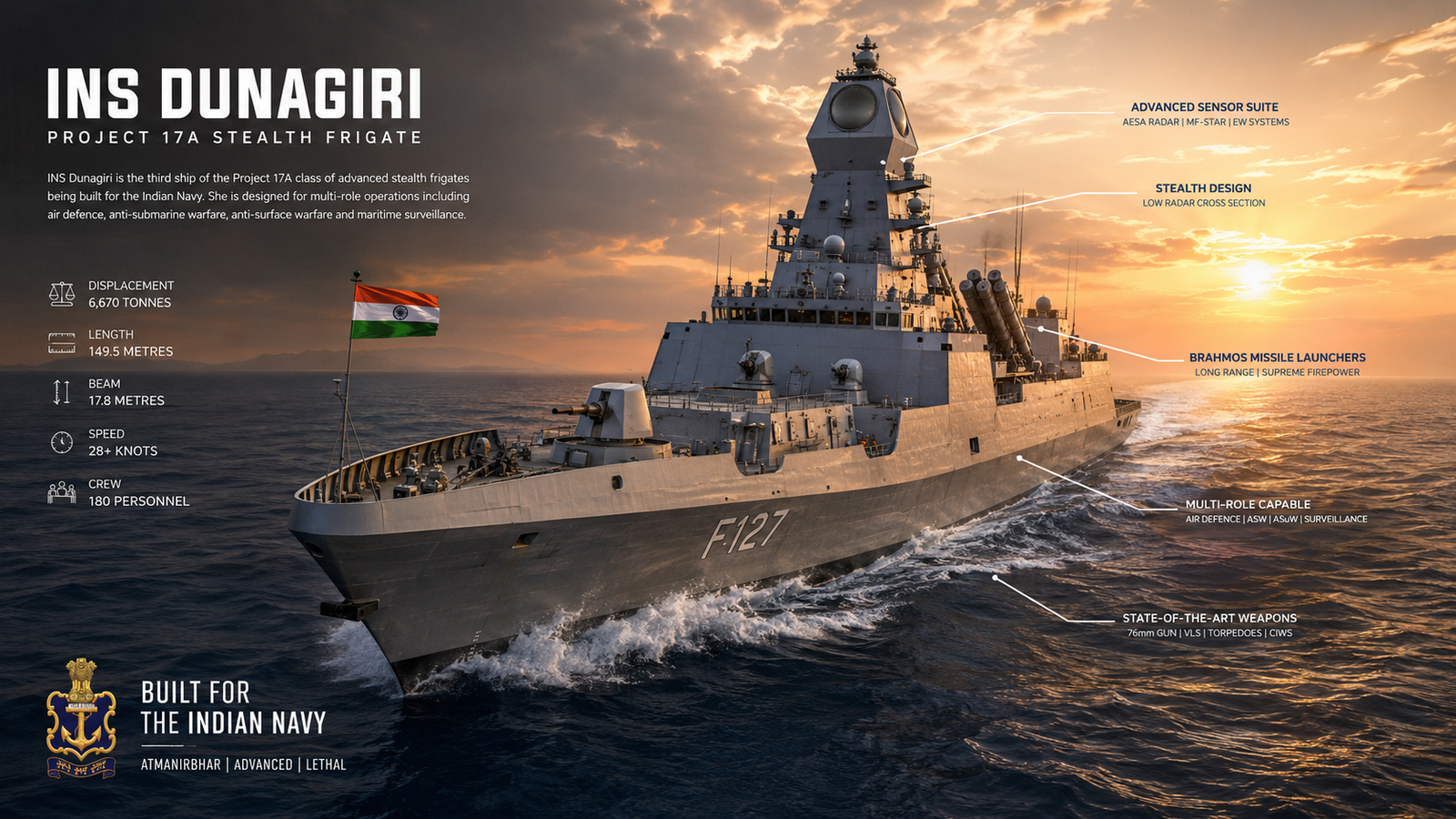
The fifth Nilgiri-class stealth guided-missile frigate (Project 17A), built by GRSE. Displacement: ~6,670 tonnes. Length: 149m. Armed with BrahMos SSM, MRSAM air defence, 76mm SRGM, 30mm & 12.7mm CIWS, plus ASW rockets & torpedoes. CODOG propulsion with IPMS. Build time compressed to 80 months (vs 93 months for lead ship INS Nilgiri). Pennant: F36.
The fourth and final Sandhayak-class SVL, completing the four-ship project (contract signed 30 Oct 2018). Length: 110m. Displacement: ~3,400 tonnes. Speed: 18+ knots. Equipped with AUVs, ROVs, DGPS positioning, Digital Side Scan Sonar, and advanced data acquisition systems. Role: coastal & deep-water hydrographic surveys, oceanographic data collection, HADR hospital ship capability. Indigenous content: 80%+.
The fourth of eight ASW Shallow Water Craft under the ₹6,311 crore GRSE contract (signed 29 April 2019). Length: 77.6m. Displacement: 900 tonnes. Waterjet propulsion for high manoeuvrability & low noise. Armed with lightweight torpedoes, indigenous ASW rocket launchers, hull-mounted & variable depth sonar. Designed for littoral submarine hunting, coastal surveillance, and mine operations. Indigenous content: 80%+. Replaces ageing Abhay-class corvettes.
All three vessels follow the Integrated Construction philosophy extensive pre-outfitting at block stages to reduce build periods. Designed by the Warship Design Bureau (WDB) with tri-services coordination. Over 200 MSMEs supplied components. SAIL’s DMR 249-A indigenous steel used extensively. Classified under Indian Register of Shipping rules. Directly aligned with Aatmanirbhar Bharat and Make in India Defence Corridor objectives.
For competitive exam aspirants, here are the most critical facts related to the 21 June 2026 triple commissioning and the technical parameters of the INS Dunagiri Sanshodhak Agray Commissioning timeline:
| Commissioning Date | 21 June 2026, Kolkata. Presided over by Prime Minister Narendra Modi. |
|---|---|
| Builder | Garden Reach Shipbuilders & Engineers (GRSE), Kolkata. All three delivered simultaneously on 30 March 2026 a first for GRSE. |
| Designer | Indian Navy’s Warship Design Bureau (WDB). |
| INS Dunagiri | Fifth Project 17A (Nilgiri-class) stealth guided-missile frigate. Pennant F36. Displacement ~6,670 tonnes. Length 149m. Armed with BrahMos SSM, MRSAM, 76mm SRGM, CIWS, ASW rockets & torpedoes. CODOG propulsion with IPMS. Build time: 80 months. |
| INS Sanshodhak | Fourth & final Sandhayak-class Survey Vessel (Large). Contract: 30 Oct 2018. Length 110m, displacement ~3,400 tonnes, speed 18+ knots. AUVs, ROVs, DGPS, Digital Side Scan Sonar. Indigenous content 80%+. Can serve as hospital ship during HADR. |
| INS Agray | Fourth Arnala-class ASW Shallow Water Craft. Contract: ₹6,311 crore (29 Apr 2019). Length 77.6m, displacement 900 tonnes. Waterjet propulsion. Lightweight torpedoes, indigenous ASW rockets, hull-mounted & VDS sonar. Indigenous content 80%+. Replaces Abhay-class corvettes. |
| Indigenous Content | Exceeds 75% across all three vessels. Over 200 MSMEs involved. SAIL DMR 249-A steel used. |
| Employment Generated | ~4,000 direct jobs and 10,000+ indirect jobs across the three projects. |
| Project 17A Status | Seven ships total: 4 by MDSL (Nilgiri, Udaygiri, Taragiri, Mahendragiri) and 3 by GRSE (Himgiri, Dunagiri, Vindhyagiri). Nilgiri commissioned Jan 2025; Udaygiri & Himgiri Aug 2025; Taragiri Apr 2026; Mahendragiri delivered Apr 2026; Vindhyagiri expected Q3 2026. |
| ASW SWC Status | 16 ships total: 8 by GRSE (Arnala-class) and 8 by CSL (Mahe-class). Arnala commissioned June 2025; Androth Oct 2025; Anjadip Feb 2026; Agray June 2026. Mahe commissioned Nov 2025. |
| SVL Project Status | Four ships: Sandhayak (Feb 2024), Nirdeshak (Dec 2024), Ikshak (Nov 2025), Sanshodhak (June 2026). All built by GRSE. |
| Policy Alignment | Aatmanirbhar Bharat, Make in India Defence Corridor, 30% indigenous content mandate in defence procurement. |
| Exam Relevance | Direct questions expected in UPSC CSE (GS-3 Defence/Sci-Tech, GS-2 IR), CDS, NDA, AFCAT, CAPF, SSC CGL, and State PSCs. |
The deep structural outcome of the INS Dunagiri Sanshodhak Agray Commissioning is far more than a fleet induction ceremony. It is a geopolitical signal to the Indo-Pacific that India’s naval shipbuilding ecosystem has reached maturity. Here’s the deep strategic breakdown:
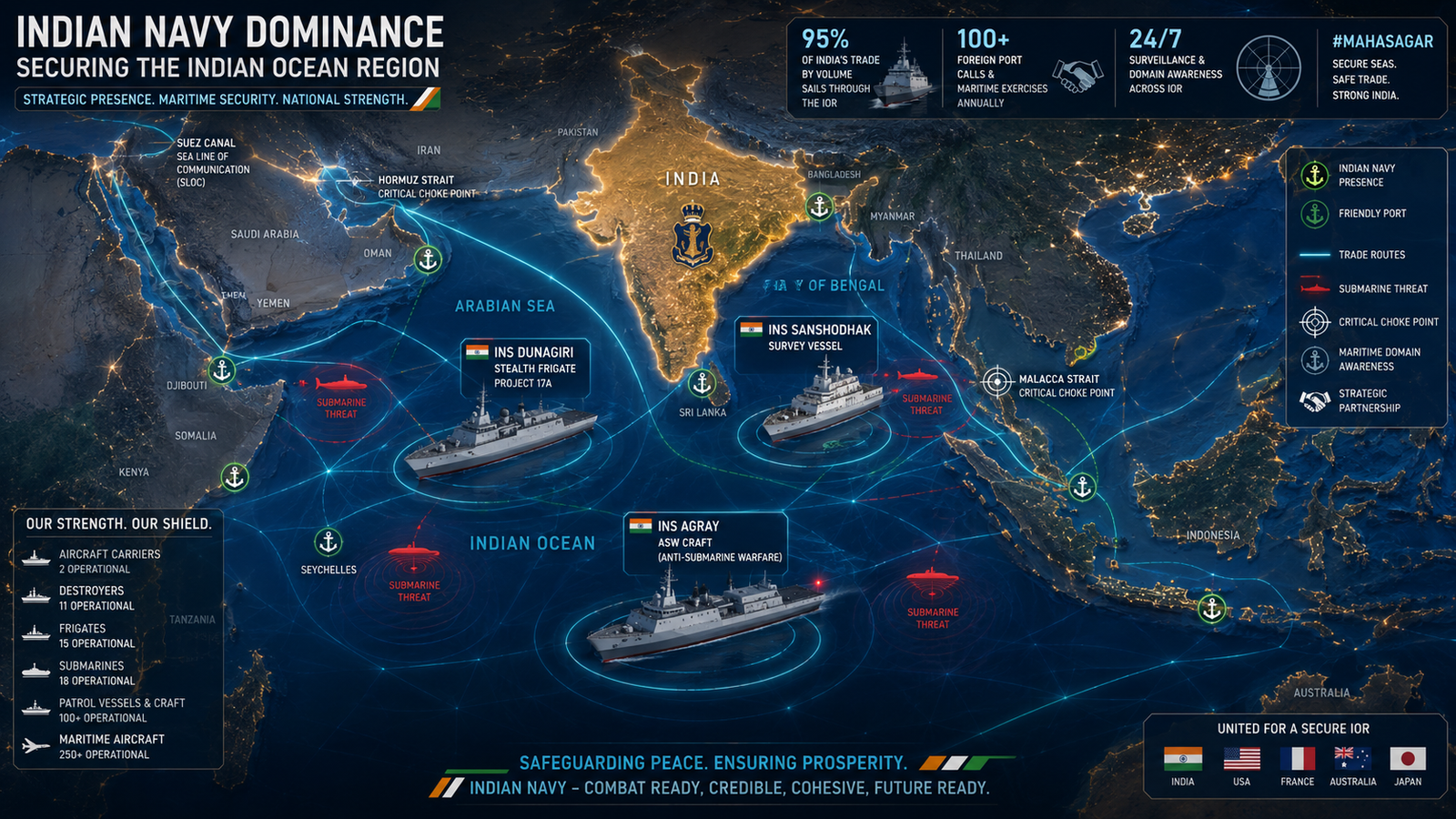
In the Indian Ocean Region (IOR), China’s People’s Liberation Army Navy (PLAN) operates a growing fleet of Type 054A frigates and Yuan-class submarines. Pakistan is expanding its submarine force with Hangor-class boats from China. The triple commissioning directly counters these threats: Dunagiri adds BrahMos strike capability to the Eastern Fleet, Agray hunts submarines in the shallow waters of the Bay of Bengal and Arabian Sea littorals, and Sanshodhak maps the seabed for safe submarine and carrier operations.
1. Blue-Water Combat Dominance: INS Dunagiri (P17A) joins the Eastern Fleet as a 6,670-tonne stealth frigate with BrahMos anti-ship/land-attack missiles and MRSAM air defence. In a contested IOR, this vessel can escort carrier battle groups, conduct independent surface action group missions, and deter PLAN frigate incursions into India’s EEZ.
2. Littoral Submarine Defence: INS Agray is purpose-built for shallow-water ASW the exact environment where Pakistani and Chinese submarines operate close to Indian shores. With waterjet propulsion (lower acoustic signature), hull-mounted sonar, and lightweight torpedoes, Agray closes a critical gap in coastal underwater warfare that the ageing Abhay-class corvettes could no longer fill.
3. Maritime Domain Awareness: INS Sanshodhak completes India’s four-ship SVL programme, giving the Navy continuous hydrographic coverage of the IOR. Accurate seabed maps are essential for submarine navigation, mine countermeasures, and safe passage of commercial shipping carrying 95% of India’s trade. The vessel’s AUV and ROV capabilities also support undersea cable inspection critical for digital security.
4. Economic Multiplier Effect: The three projects involved over 200 MSMEs and generated ~14,000 total jobs. This demonstrates that defence shipbuilding is not just a strategic activity but an economic engine. The ₹6,311 crore ASW SWC contract alone sustains a shipbuilding supply chain that feeds into civilian shipbuilding, port infrastructure, and marine engineering education.
5. Export Potential: GRSE has already exported warships to Mauritius and Seychelles. The proven track record of P17A frigates and ASW SWCs positions India as a competitive exporter in the global naval market particularly for Southeast Asian and African navies seeking cost-effective, indigenous-built platforms.
Defencera’s Final Strategic Take: The strategic footprint of the 21 June 2026 triple commissioning represents the new face of Indian naval power where indigenous design, accelerated production, and multi-domain capability converge in a single ceremony. For competitive exam aspirants, this is not just a current affairs headline; it is a case study in how strategic vision, industrial policy, and maritime geography intersect to shape India’s position as a leading blue-water navy by 2030.
This INS Dunagiri Sanshodhak Agray Commissioning milestone is directly linked to your upcoming exam syllabi. Here’s how examiners may frame questions around this topic:
Indigenization of defence technology, Aatmanirbhar Bharat in defence manufacturing, Science & Technology applications in national security, public sector shipyard performance (GRSE, MDSL, CSL), MSME integration in defence supply chains, and the role of indigenous steel (SAIL DMR 249-A) in warship construction.
India’s maritime security architecture in the Indo-Pacific, SAGAR and MAHASAGAR visions, Indo-Pacific strategic dynamics, India-China naval competition in the Indian Ocean Region, and the role of UNCLOS in maritime dispute resolution. Also relevant for questions on PM’s role in defence ceremonies and constitutional provisions for defence under the Union List.
Evolution of Indian Navy frigates (Leander → Brahmaputra → Shivalik → Nilgiri/P17A), ASW capabilities and shallow water warfare, hydrographic survey importance for submarine operations, CODOG propulsion systems, BrahMos missile integration on naval platforms, and the strategic significance of the Eastern Fleet.
Direct one-liner questions: “Which shipyard built INS Dunagiri?” (GRSE Kolkata), “What class is INS Agray?” (Arnala-class ASW SWC), “When is the triple commissioning?” (21 June 2026), “Who will preside?” (PM Modi), “What is the indigenous content?” (75%+), or “How many P17A frigates are planned?” (Seven total).
Ordinary current affairs won’t cut it. Stay one step ahead in your exams by joining our exclusive network for defence and strategic updates.