MoD Backs ₹500 Cr Military Drone Technology Centre at IIT Kanpur: Notes for UPSC, CAPF, CDS, NDA, SSC & Railway | Defencera
🚨 BREAKING DEFENCE UPDATE | STRATEGIC MILESTONE

MoD Backs ₹500 Cr Military Drone Technology Centre at IIT Kanpur:
India’s AI-Powered UAV Revolution Takes Flight
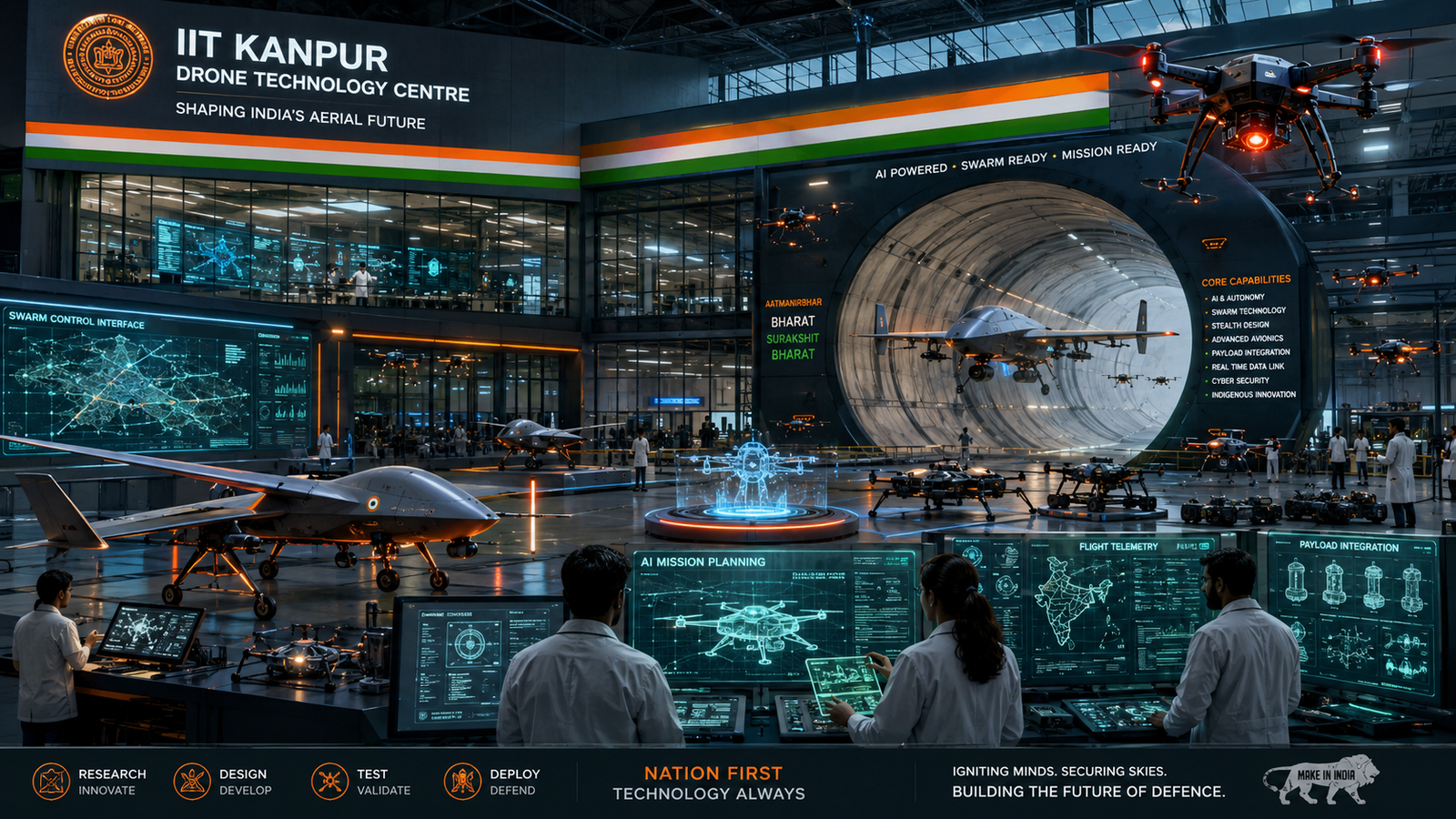
Military Drone Technology Centre at IIT Kanpur

The Ministry of Defence (MoD) has officially sanctioned the establishment of a premier Military Drone Technology Centre at IIT Kanpur with an authorized project outlay of ₹500 crore. This landmark strategic announcement, delivered in June 2026, marks a massive structural shift in India’s Aatmanirbhar defence ecosystem. The centre will serve as the nation’s premier hub for developing indigenous unmanned aerial vehicles (UAVs), counter-drone systems, and next-generation swarm warfare technologies.

With global drone warfare reshaping modern battlefields—from Ukraine to the Middle East—India is now positioning itself as a self-reliant drone superpower. IIT Kanpur, already a pioneer in aerospace engineering through its National Aerospace Laboratories (NAL) collaborations and Aerial Delivery Research and Development Establishment (ADRDE) partnerships, will now house India’s most advanced military drone R&D facility. This move directly aligns with the Aatmanirbhar Bharat vision and the Make in India defence corridor strategy.

₹500 Cr

Total project outlay sanctioned by MoD for establishing the military drone technology centre at IIT Kanpur under the Defence Research and Development framework.

IIT Kanpur

Premier technical institution hosting the centre. Already leads India’s UAV research with proven track record in aerospace and autonomous systems development.

AI + Swarm

Core focus areas: Artificial Intelligence-powered autonomous drones, counter-UAV systems, swarm warfare tech, and next-gen military UAV platforms for tri-services.

2026-2030

Projected operational timeline. Phase 1 infrastructure by 2027, full R&D capabilities by 2028, with indigenous drone deployment for armed forces by 2030.
The Strategic Breakthrough: Why This Matters Now

The ₹500 crore military drone technology centre at IIT Kanpur is not merely an academic grant—it is a strategic defence imperative. In recent years, drone warfare has evolved from reconnaissance support to frontline combat roles. The Russia-Ukraine conflict demonstrated how cheap, swarm-capable drones can neutralize billion-dollar armour. China’s aggressive UAV deployment along the LAC and Pakistan’s drone infiltration attempts into Jammu & Kashmir have exposed India’s urgent need for indigenous counter-drone and offensive UAV capabilities.

IIT Kanpur brings unmatched credentials to this mission. The institute’s Department of Aerospace Engineering has already developed multiple UAV prototypes, including high-altitude long-endurance (HALE) platforms. Its Smart Materials, Structures, and Systems (SMSS) Lab works on cutting-edge autonomous navigation. The new MoD-backed centre will integrate these existing strengths with dedicated military-grade funding, classified research protocols, and direct tri-services (Army, Navy, Air Force) collaboration channels.

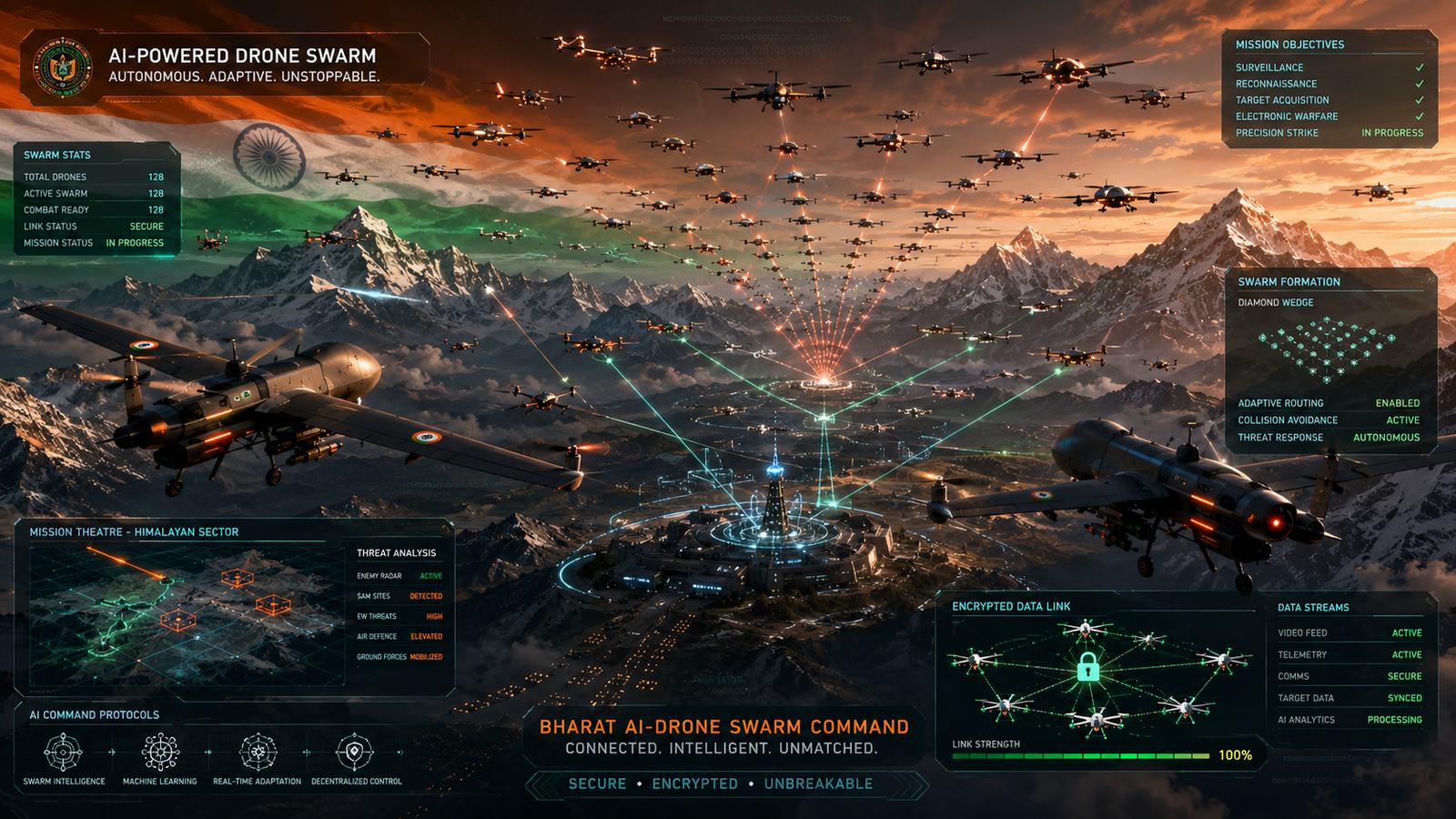
Military Drone Swarm Technology AI Warfare Visualization
📊 DEFENCERA DRONE TECH EVOLUTION SIMULATOR
Track India’s drone technology journey from imported dependency to indigenous dominance:
Phase 1: Import Dependency Era (2000-2015) – Israel’s Heron and Searcher drones dominated Indian skies

Technical Architecture: What the Centre Will Build

The military drone technology centre at IIT Kanpur will be structured around four core verticals, each addressing critical gaps in India’s current defence capabilities. This is not a generic research lab—it is a mission-mode facility designed to deliver battlefield-ready systems within strict timelines.

Autonomous Combat UAVs

Development of AI-powered strike drones capable of autonomous target identification, threat assessment, and precision engagement. Focus on loitering munitions (kamikaze drones) and medium-altitude long-endurance (MALE) platforms with satellite communication links for beyond-line-of-sight operations.

Counter-Drone Defence Systems

Creating integrated counter-UAV architectures combining radar detection, RF jamming, laser-based hard-kill systems, and AI-driven swarm interception drones. Critical for protecting military bases, nuclear installations, and border outposts from Pakistani and Chinese drone threats.

Swarm Warfare Technology

Pioneering decentralized AI algorithms that enable hundreds of small drones to operate as a single intelligent unit. Swarm drones can overwhelm enemy air defences, conduct distributed surveillance, and execute coordinated saturation attacks—technology where China currently leads globally.

High-Altitude & Arctic UAVs

Specialized drones for Ladakh and Siachen operations at 18,000+ feet, featuring cold-weather batteries, ice-resistant rotors, and hypoxia-tolerant propulsion. These will replace human patrols in the world’s highest battlefield, reducing casualties while maintaining 24/7 surveillance.

The centre will feature state-of-the-art wind tunnels for aerodynamic testing, anechoic chambers for RF signature analysis, and a dedicated outdoor flight test range spanning over 500 acres near Kanpur. Collaboration with DRDO’s Aeronautical Development Establishment (ADE), Bharat Electronics, and private players like ideaForge and DroneAcharya will ensure rapid technology transfer from lab to battlefield.

✨ DEFENCERA DEFENCE AWARENESS CHALLENGE
Question: The ₹500 crore military drone technology centre sanctioned by MoD at IIT Kanpur will primarily focus on which of the following core technology areas?
A) Nuclear submarine propulsion systems and underwater drone torpedoes
B) Conventional manned fighter jet engine development and stealth coating
C) AI-powered autonomous UAVs, counter-drone systems, and swarm warfare technology
D) Satellite launch vehicle (SLV) design and intercontinental ballistic missiles
Correct Answer: C (AI-powered autonomous UAVs, counter-drone systems, and swarm warfare technology)!

Explanation: The MoD’s ₹500 crore centre at IIT Kanpur is specifically designed to develop indigenous unmanned aerial vehicle (UAV) capabilities. The four core verticals are: (1) Autonomous Combat UAVs with AI target identification, (2) Counter-Drone Defence Systems for base protection, (3) Swarm Warfare Technology using decentralized AI algorithms, and (4) High-Altitude & Arctic UAVs for Ladakh/Siachen operations. This directly addresses India’s strategic vulnerabilities exposed by Chinese drone deployments along the LAC and Pakistani drone infiltration in J&K.

High-Yield Intelligence Matrix: Essential Exam Data Grid

For competitive exam aspirants, here are the most critical facts related to the MoD-IIT Kanpur Military Drone Technology Centre:

Sanctioned ByMinistry of Defence (MoD), Government of India — announced June 2026.
Project Outlay₹500 crore total funding for establishing the military drone technology centre.
Host InstitutionIndian Institute of Technology (IIT) Kanpur — premier technical institute with existing aerospace and UAV research infrastructure.
Core Focus AreasAI-powered autonomous UAVs, counter-drone (counter-UAV) defence systems, swarm warfare technology, and high-altitude military drones.
Strategic ContextAddresses LAC drone threats from China, Pakistani drone infiltration in J&K, and lessons from Ukraine-Russia drone warfare.
Key CollaboratorsDRDO (ADE, ADRDE), Bharat Electronics, ideaForge, DroneAcharya, and tri-services (Army, Navy, Air Force).
Existing IIT-K AssetsDepartment of Aerospace Engineering, SMSS Lab (autonomous navigation), NAL collaborations, and prior UAV prototype development.
Facility FeaturesWind tunnels, anechoic chambers, 500+ acre outdoor flight test range, classified research protocols, and tri-services liaison office.
Policy AlignmentAatmanirbhar Bharat (Self-Reliant India), Make in India Defence Corridor, and 30% indigenous content mandate in defence procurement.
TimelinePhase 1 infrastructure by 2027, full R&D operational by 2028, indigenous drone deployment for armed forces by 2030.
Global ContextChina leads in military drone swarm tech; Turkey (Bayraktar TB2) and Israel (Hermes 450) dominate export markets. India aims self-reliance.
Exam RelevanceDirect questions expected in UPSC CSE (GS-3 Science & Technology, GS-2 Defence), CDS, NDA, AFCAT, CAPF, and SSC CGL.

Strategic Analysis: The Geopolitical Game-Changer

The ₹500 crore military drone technology centre at IIT Kanpur is far more than a research grant—it is a geopolitical chess move that reshapes India’s position in the global drone warfare landscape. Here’s the deep strategic breakdown:

For decades, India’s drone fleet relied heavily on Israeli imports—Heron Mk II for surveillance and Harop for loitering strikes. While reliable, this dependency created vulnerabilities: supply chain risks, technology denial scenarios, and inability to customize platforms for Himalayan warfare. The Ukraine conflict shattered the illusion that expensive manned aircraft alone guarantee air superiority. Cheap, AI-coordinated drone swarms can neutralize tanks, destroy airfields, and cripple logistics networks at a fraction of the cost.

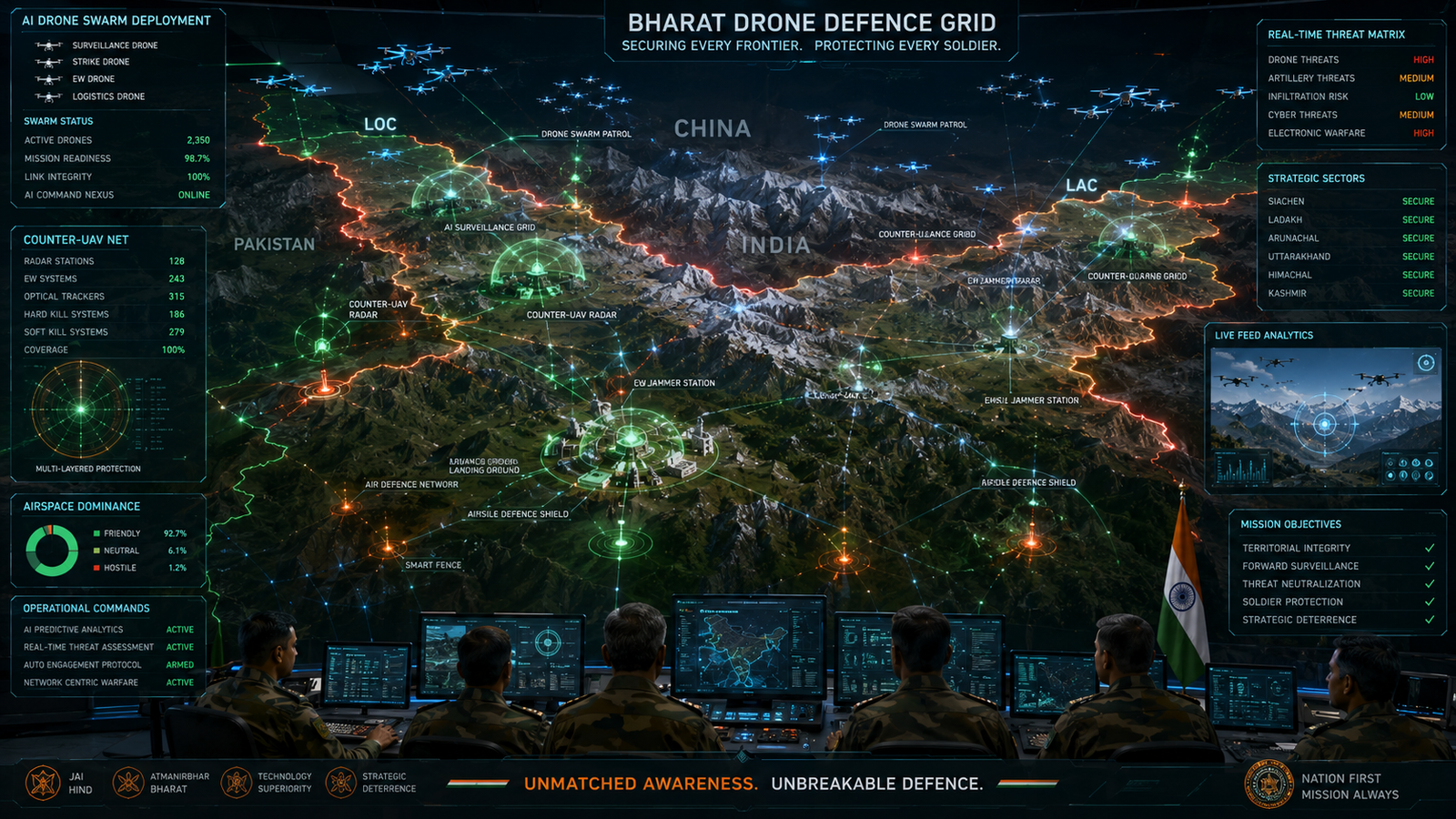
India Military Drone Strategic Map LAC Counter UAV Defence

Strategic Defence Telemetry Blueprint

1. Countering the Chinese Drone Threat: China operates the world’s largest military drone fleet, including the Wing Loong series and advanced swarm technologies deployed along the LAC. The IIT-Kanpur centre will develop indigenous counter-drone systems—combining radar, RF jamming, and laser hard-kill—to neutralize this threat without escalating to manned air combat.

2. Securing Jammu & Kashmir: Pakistani terror groups have increasingly used commercial drones to drop weapons and IEDs across the border in J&K. The centre’s counter-UAV vertical will deliver portable, base-level protection systems for every BSF and Army outpost along the IB and LoC.

3. Economic Defence Corridors: The drone centre feeds into India’s broader ₹1.25 lakh crore defence production target by 2026. By developing indigenous UAVs, India can capture a share of the global military drone market (projected at $30 billion by 2030) while reducing import bills by over ₹15,000 crore annually.

4. Civilian-Military Dual Use: Technologies developed at the centre—autonomous navigation, AI vision systems, and swarm algorithms—will spin off into civilian applications: precision agriculture, disaster response, infrastructure monitoring, and smart city surveillance, creating a multiplier effect on the ₹500 crore investment.

5. Talent Pipeline for DRDO: The centre will train 500+ aerospace engineers annually in military-grade drone technology, creating a human capital pipeline that feeds directly into DRDO, HAL, private defence startups, and the armed forces’ technical branches.

Defencera’s Final Strategic Take: The MoD-IIT Kanpur Military Drone Technology Centre represents the new face of Indian defence preparedness—where academic excellence, strategic funding, and battlefield urgency converge. For competitive exam aspirants, this is not just a current affairs headline; it is a case study in how technology, policy, and national security intersect in the 21st century. Understanding this project means understanding India’s path to becoming a true drone superpower by 2030.

🚨 Stay Ahead: Premium Defence & National Security News!

Don’t rely on clickbait and outdated news. Get real-time, verified intelligence on defence procurement, border updates, and strategic infrastructure from our exclusive news hub.

Visit News Hub 📰

🔥 90% of Students Fail Due to Outdated Current Affairs!

Stop reading useless news! Unlock our Premium Daily & Weekly Current Affairs Hub. We filter only exam-relevant defence and strategic updates that directly appear in your question papers.

Access CA Hub 🚀

Competitive Exam Connection Grid

This MoD-IIT Kanpur Military Drone Technology Centre project is directly linked to your upcoming exam syllabi. Here’s how examiners may frame questions around this topic:

General Studies Paper III Concepts

Indigenization of defence technology, Aatmanirbhar Bharat in defence manufacturing, Science & Technology applications in national security, DRDO-IIT collaboration models, and the role of autonomous systems in modern warfare. Questions on defence R&D funding mechanisms and public-private partnerships.

General Studies Paper II Concepts

Centre-state cooperation in defence research (IITs are centrally funded institutions), the role of technical education in national security, and constitutional provisions for defence under the Union List. Also relevant for questions on India’s foreign policy vis-à-vis defence technology imports.

Defence and Strategic Papers

Evolution of drone warfare globally, India’s UAV inventory (Heron, Rustom, TAPAS BH-201), counter-drone strategies for LAC and LoC, swarm warfare concepts, and the strategic importance of indigenous defence manufacturing. Direct questions on IIT Kanpur’s aerospace contributions.

One-Day Objective Exams

Direct one-liner questions: “Where is India’s ₹500 Cr military drone technology centre being established?” (IIT Kanpur), “Which ministry sanctioned the drone tech centre?” (MoD), or “What is the primary focus of the new IIT-Kanpur defence centre?” (AI UAVs, counter-drone, swarm tech).

Join the Elite Intelligence Network

Ordinary current affairs won’t cut it. Stay one step ahead in your exams by joining our exclusive network for defence and strategic updates.

WhatsApp WhatsApp Telegram Telegram Join Telegram

Scroll to Top
