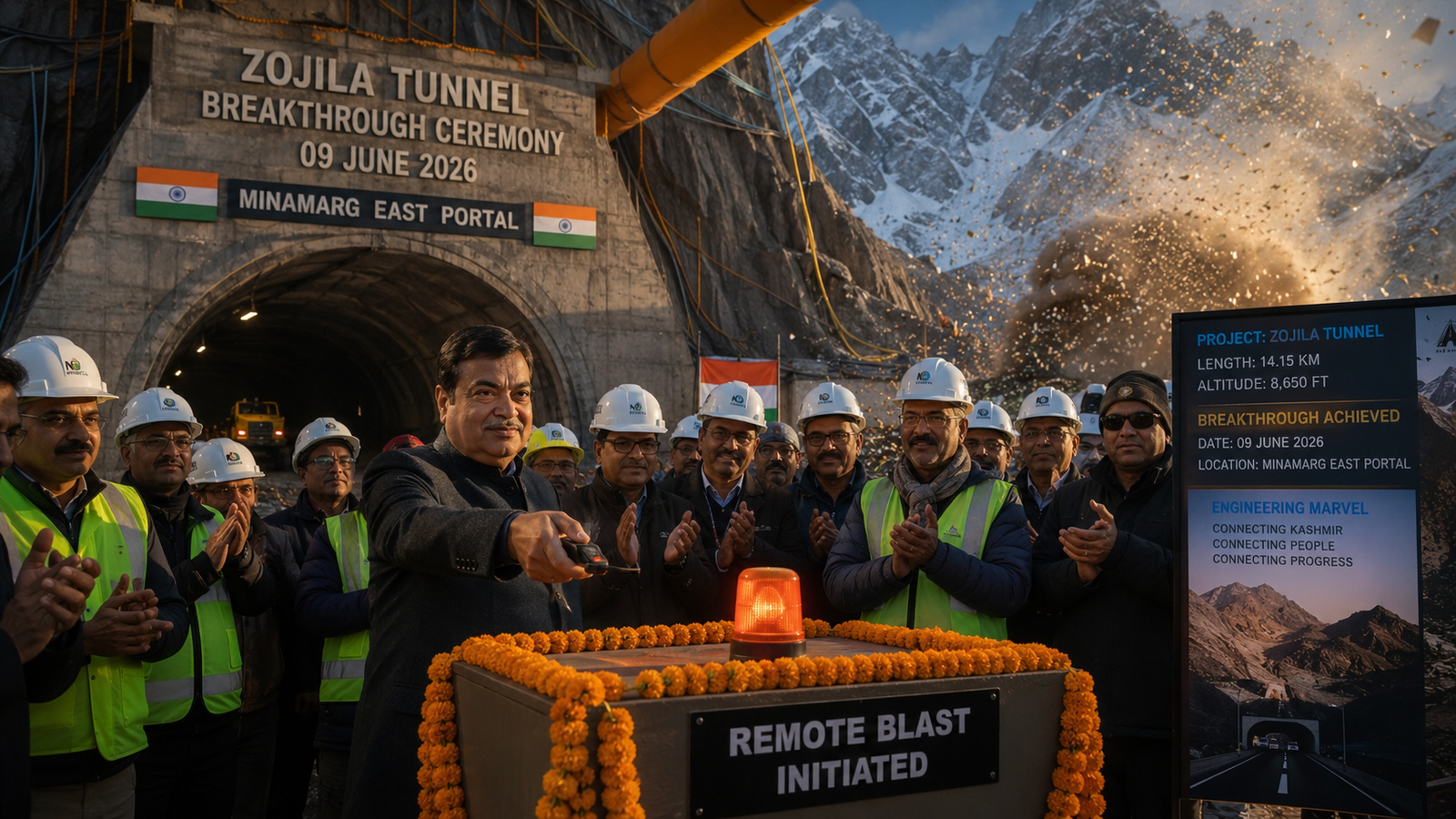
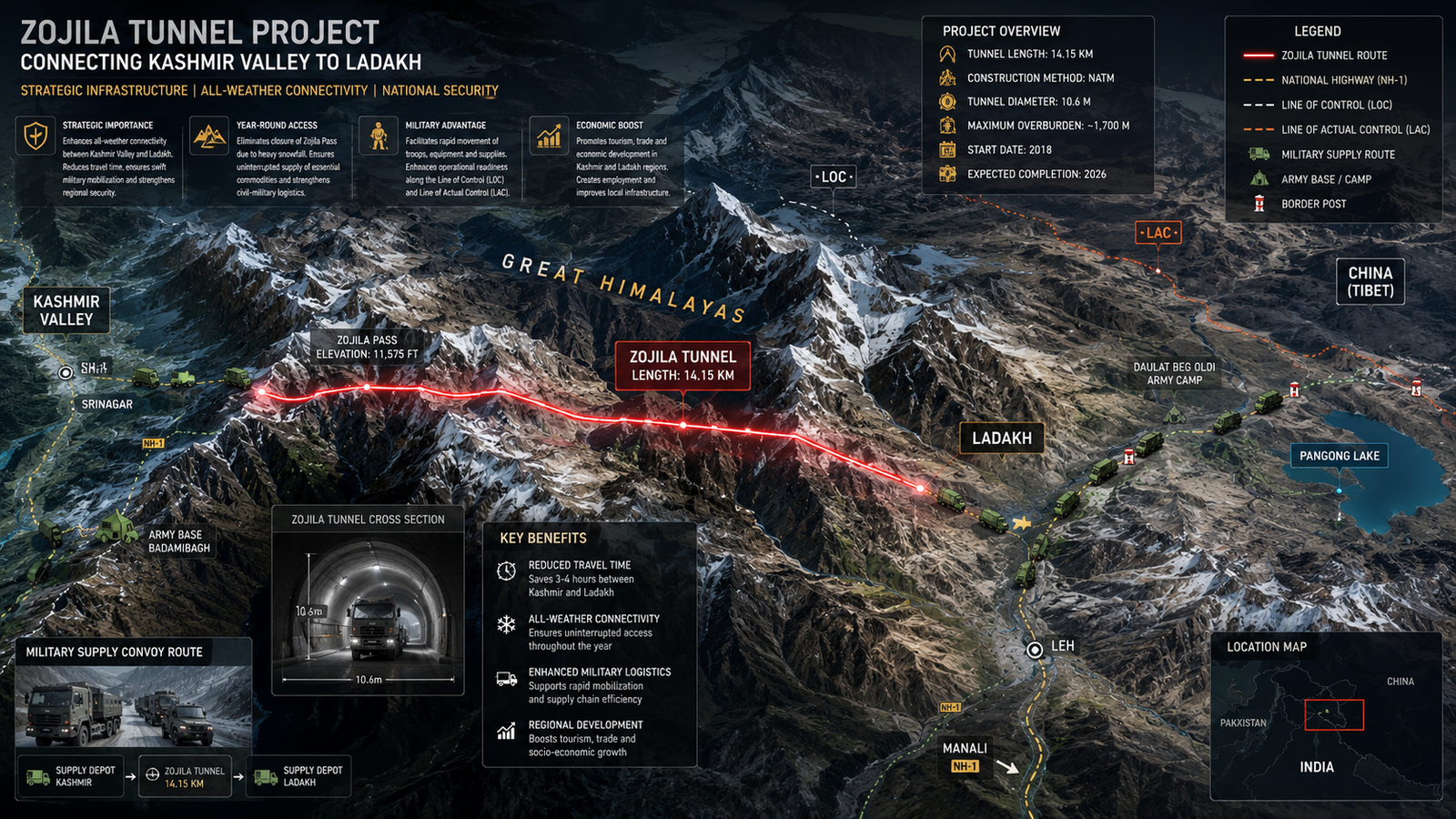
The Zojila Tunnel Breakthrough 2026 marks a massive engineering milestone for India, achieved on 9 June 2026. Union Minister Shri Nitin Gadkari successfully triggered the final breakthrough blast for the tunnel at the eastern portal in Minamarg, Kargil. This marks the end of the crucial excavation phase for what will be India’s longest road tunnel and the world’s longest single-tube bi-directional road tunnel at high altitude. Spanning roughly 14 km through tough Himalayan terrain between 2,900 to 3,310 metres, this tunnel is set to finally provide year-round, uninterrupted connectivity between Jammu & Kashmir and Ladakh—effectively ending decades of harsh winter isolation.
Total tunnel length — making it India’s longest road tunnel and the world’s longest single-tube bi-directional tunnel at this altitude.
Approximate project cost. Executed by NHIDCL under MoRTH, and constructed by MEIL using advanced NATM technology.
Operating altitude. Designed as a horseshoe-shaped single tube (9.5m wide, 7.57m high) supporting speeds up to 80 kmph.
Expected opening date for the public. The breakthrough was achieved 6 months ahead of schedule, with ~85% total work completed.
The breakthrough event at Minamarg was a proud moment for the nation. Union Minister for Road Transport & Highways, Shri Nitin Gadkari, pressed a remote button to trigger a controlled blast that shattered the final 2.5 metres of rock. This blast finally connected the two excavation teams who had been relentlessly boring through the mountains from opposite ends. Jammu & Kashmir Lieutenant Governor Shri Manoj Sinha and Chief Minister Shri Omar Abdullah attended in person, while Ladakh Lieutenant Governor Shri Vinai Kumar Saxena joined virtually to celebrate the achievement.
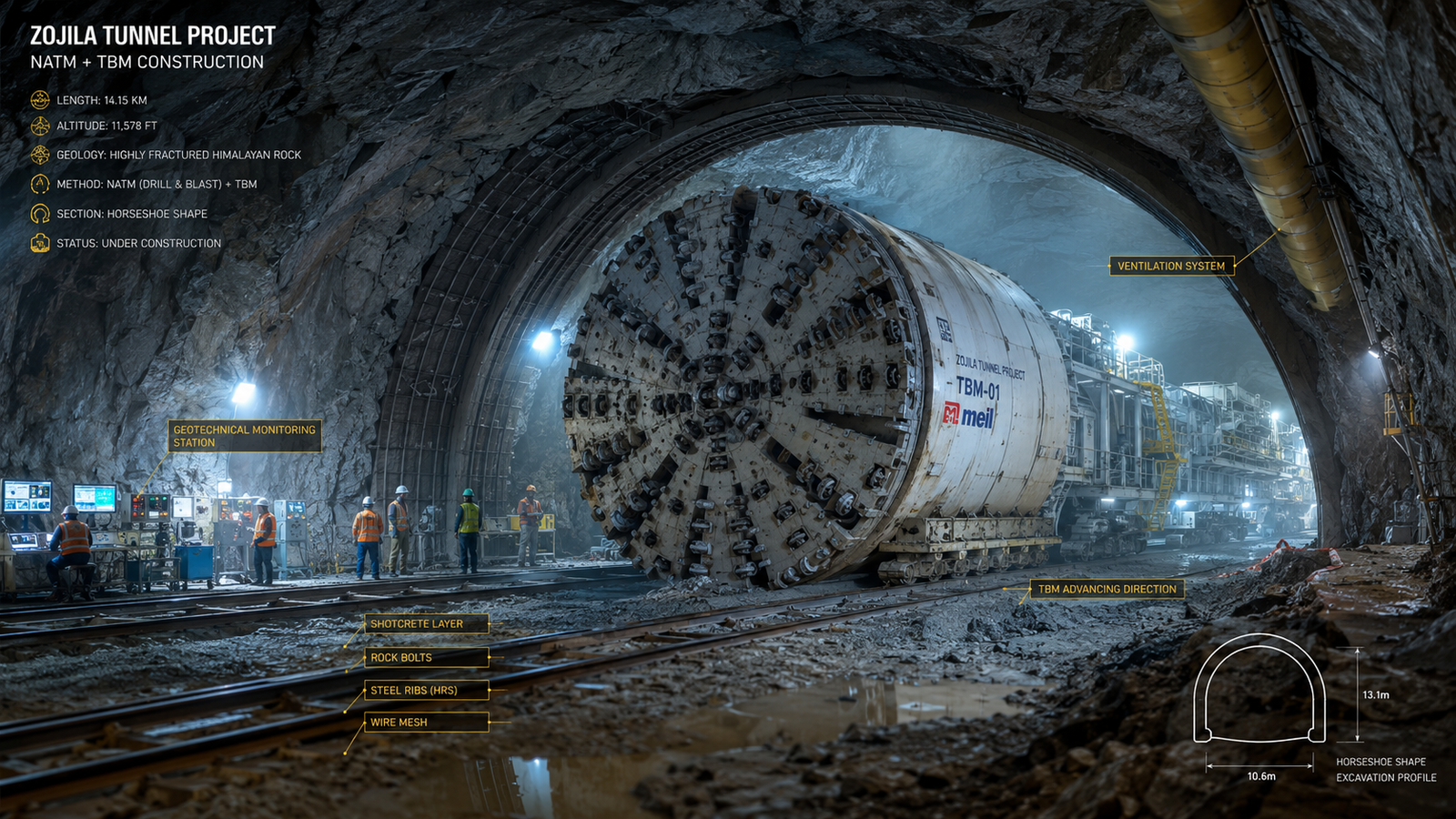
To pull this off, engineers relied on the New Austrian Tunnelling Method (NATM). It is a highly flexible excavation technique perfectly suited to handle the unpredictable and fragile geology of the Himalayas, especially in a highly sensitive Seismic Zone IV region. According to MEIL’s General Manager Siva Prasad Reddy, NATM uses sequential digging, immediate rock bolting for support, and continuous monitoring of the soil and rocks. This allowed the teams to adapt dynamically to changing conditions underground, ensuring maximum safety and steady progress.
The Zojila Tunnel isn’t just a hole through a mountain; it’s one of the toughest engineering challenges ever taken up in the Himalayas. The entire project isn’t limited to the main 13.153 km tunnel. It actually covers a 30.894 km corridor from Sonamarg to Minamarg, which includes two smaller tunnels at Nilgrar (457m and 1,953m), four bridges, 40 culverts, eight cut-and-cover sections, and heavy-duty avalanche protection structures.
The tunnel will be equipped with an advanced Supervisory Control and Data Acquisition (SCADA) system. This ensures real-time monitoring of operations, automatic fire detection, round-the-clock CCTV surveillance, and a dedicated emergency phone network to meet global safety standards.
Because the tunnel is so long and located at such a high altitude where oxygen is thin, engineers have built three massive vertical shafts. These act as the lungs of the tunnel, providing vital ventilation and serving as emergency access points.
The areas approaching the tunnel are notorious for heavy snowfall—the Zojila Pass gets snowed in for 8 months a year. To counter this, the project includes snow galleries, catch dams, and deflector structures designed to keep the road clear and safe regardless of winter storms.
The Himalayan region where the tunnel is built is highly prone to earthquakes (Seismic Zone IV). To ensure the structure can absorb severe shocks, the NATM construction methodology and flexible tunnel supports have been heavily reinforced.
This massive project is designed to link up directly with the already operational Z-Morh Tunnel (Sonamarg Tunnel), which opened in January 2025. Together, they form an uninterrupted all-weather corridor that completely bypasses the deadly Zojila Pass—a 16,430 ft high treacherous road that used to shut down for over half the year.
Here are the most critical, direct data points you need to remember for your competitive exams regarding the Zojila Tunnel Breakthrough 2026:
| Breakthrough Date | 9 June 2026 (Tuesday) — Final 2.5m blast triggered by Nitin Gadkari at the Minamarg East Portal. |
|---|---|
| Tunnel Length | 13.153 km (main tunnel) — India’s longest road tunnel. The total project corridor is 30.894 km including approach roads. |
| Altitude & Dimensions | 11,578 feet above sea level. It is 9.5m wide and 7.57m high, featuring a horseshoe-shaped single-tube, bi-directional design. |
| Project Cost | Approximately ₹6,800 crore. (Revised from the initial ₹8,308 crore after EPC remodeling saved ₹3,835 crore). |
| Nodal Agency | National Highways & Infrastructure Development Corporation Limited (NHIDCL) under MoRTH. |
| Contractor | Megha Engineering & Infrastructure Limited (MEIL) — Awarded the EPC contract in August 2020 at ₹4,509.50 crore. |
| Construction Method | New Austrian Tunnelling Method (NATM) focusing on sequential excavation and immediate rock bolting. |
| Route & Connectivity | Connects Baltal (near Sonamarg, J&K) to Minamarg (near Drass, Kargil district, Ladakh) on NH-1. |
| Travel Time Impact | Cuts the Sonamarg-Minamarg travel time from 1.5-2 hours down to just 15-30 minutes, bypassing the hazardous 16,430 ft Zojila Pass. |
| Completion Target | Full public operational opening is expected in February 2028. The breakthrough was achieved 6 months early. |
| Safety Features | Smart Tunnel SCADA, automatic fire detection, CCTV surveillance, 3 vertical ventilation shafts, and emergency cross-passages. |
| Associated Tunnels | Z-Morh Tunnel (operational since Jan 2025) and Nilgrar Twin Tunnels (457m and 1,953m). |
| Historical Context | The Zojila Pass was captured by Pakistani raiders in May 1948 but was recaptured under Operation Bison on 1 Nov 1948—which remains one of the highest altitude tank combats in history. |
Make no mistake, the Zojila Tunnel Breakthrough 2026 is far more than just a road project—it is a massive geopolitical game-changer. For years, Ladakh has been cut off from the rest of the country for 6-7 months every winter. This isolation forced the military to rely heavily on expensive and weather-dependent airlifts to supply troops and civilians. That vulnerability is now a thing of the past.
1. Military Logistics Revolution: With the tunnel complete, Ladakh’s winter isolation ends. The Indian Army can now seamlessly deploy troops, heavy armor, fuel, and rations to the Line of Actual Control (LAC) and the Line of Control (LOC) 365 days a year. It permanently erases the strategic choke points that were dangerously exposed during the 1999 Kargil War.
2. Economic & Tourism Catalyst: Year-round road access will revolutionize Ladakh’s local economy. Famous spots like Sonamarg, Drass, Kargil, and Pangong Lake will now see uninterrupted tourism, boosting local businesses, trade, and employment.
3. ₹1.35 Lakh Crore J&K Push: The Zojila Tunnel is the flagship structure within a massive ₹1.35 lakh crore highway development network transforming Jammu & Kashmir, which includes multiple high-speed corridors.
4. Ladakh Tunnel Network: This isn’t an isolated project. An additional ₹18,000 crore is being invested in tunnels along the Kargil-Leh and Manali-Leh axes (including Fatu-La, Kela Pass, and Shinku La), turning the entire region into an impenetrable logistical fortress.
5. Operation Bison Legacy (1 Nov 1948): History buffs and defence aspirants must remember Operation Bison. In 1948, the 7th Cavalry dismantled Stuart light tanks, carried them up the mountains, and reassembled them at over 11,500 feet to push out Pakistani raiders from Zojila. Today’s tunnel is a permanent tribute to that monumental sacrifice.
Defencera Final Strategic Take: The successful Zojila Tunnel Breakthrough 2026 highlights the power of a New India. It proves that we can turn impossible geographical barriers into strategic assets. For anyone preparing for competitive exams, this is a textbook example of how critical infrastructure acts as a force multiplier—sometimes, steel and concrete are just as vital as guns and ammunition.
This massive infrastructure achievement is bound to show up in your upcoming exams. Here is how examiners are likely to frame questions around the Zojila Tunnel Breakthrough 2026:
Expect questions regarding border infrastructure development, strategic connectivity, the execution role of NHIDCL under MoRTH, PPP models (like EPC vs HAM), and the overall economic boost for Himalayan states.
Possible questions on Centre-State relations, the administrative roles of LGs in UTs like J&K and Ladakh, and the governance of inter-state highway development under the Union List.
Highly relevant for topics covering the strategic geography of Ladakh, LAC/LOC supply chain logistics, historical context like Operation Bison (1948) and the Kargil War (1999), and tunnel warfare logistics.
Be ready for direct factual questions: “What is the total length of the Zojila Tunnel?” (13.153 km), “Which method was used for construction?” (NATM), or “Which agency executed the project?” (NHIDCL/MEIL).
Stop settling for average, scattered current affairs. Get direct access to deep, structured breakdowns and exclusive defence updates designed to give you a sharp analytical edge in your exams.