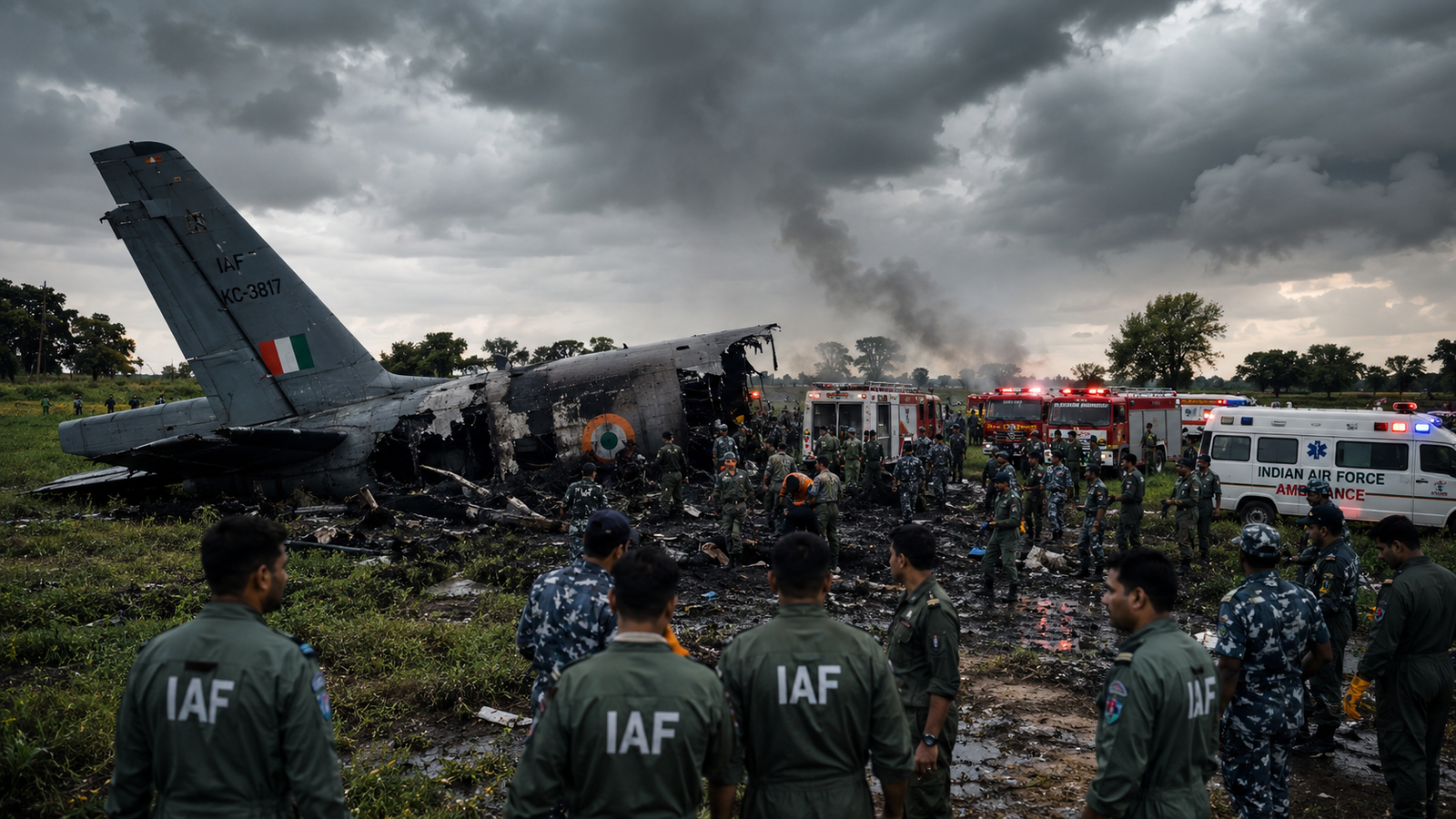
Tragedy struck the Eastern skies on Saturday morning when an Indian Air Force Antonov An-32RE tactical transport aircraft crashed during a critical landing phase. This devastating IAF An-32 crash Jorhat incident occurred at Jorhat-Rowriah Airport in Assam. The aircraft, registered as KA2678 under the 43 Squadron, suffered a catastrophic runway excursion, veering off runway 04 and igniting into a massive inferno. Five courageous air warriors made the supreme sacrifice in the line of duty, while the co-pilot was pulled from the wreckage and continues to fight for his life.
Sqn Ldr Prashant Singh, Flt Lt Shubham Kumar, Sgt Jitendra Sharma, Agniveervayu Khemaram & Danish Alam
An-32RE aircraft (MSN 0203) operated by 43 Squadron under Eastern Air Command
The co-pilot pulled from wreckage alive, now undergoing intensive medical treatment
Court of Inquiry ordered by IAF HQ to determine exact cause of catastrophic landing failure
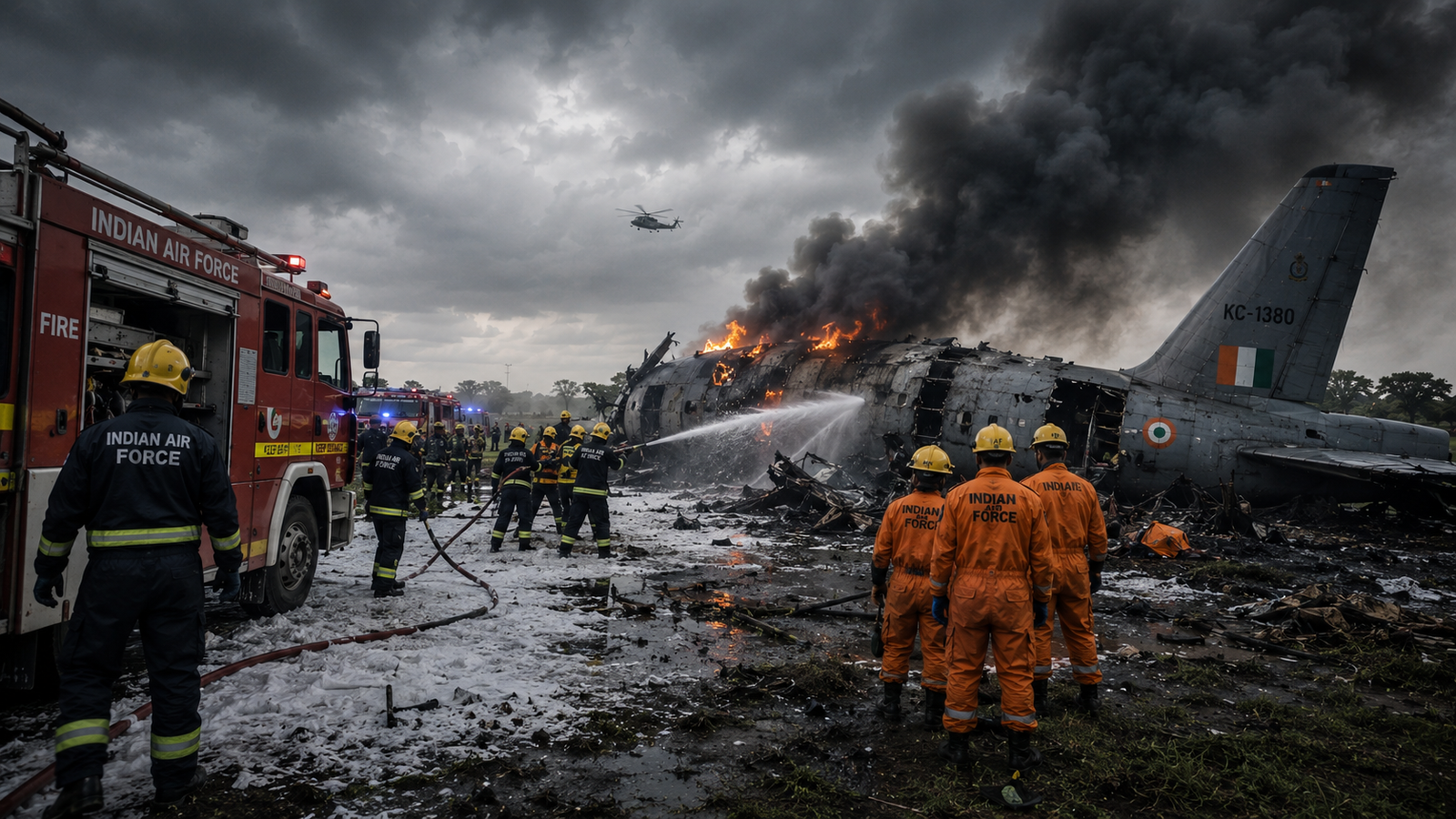
The aircraft was executing its return from a routine logistical sortie when the disaster unfolded during the final approach. Eyewitness accounts indicate that the An-32 experienced a severe hard touchdown on runway 04. Immediately following the impact, the aircraft inexplicably veered left, leaving the designated landing strip. The sheer physical stress of the IAF An-32 crash Jorhat runway excursion caused an immediate structural failure as the heavy undercarriage sank into the unpaved, soft ground adjacent to the tarmac.
The immense impact ruptured the primary fuel tanks, sparking an uncontrollable blaze that engulfed the 40-year-old airframe in mere moments. Airbase emergency response teams mobilized instantly, deploying heavy firefighting foam. However, the extreme thermal intensity of the aviation fuel fire severely hampered rescue operations, reducing the forward fuselage to a charred shell before the flames were fully subdued.
The Indian Air Force has officially released the names of the five personnel who perished in the line of duty during the IAF An-32 crash Jorhat disaster. Their unwavering dedication highlights the inherent, daily risks associated with military aviation in one of India’s most unforgiving operational environments:
An exceptionally experienced pilot who was commanding the sortie. He held a distinguished service record across multiple high-risk operational deployments within the Eastern theatre.
A promising young officer in the early stages of his operational career. He represented the new generation of IAF aviators entrusted with mastering legacy platforms in complex terrain.
A highly skilled technical aircrew member responsible for vital flight engineering and critical cargo operations, ensuring the seamless link between cockpit commands and airframe response.
The newest, bravest entrants to military service under the Agnipath scheme, demonstrating the ultimate sacrifice from the fresh blood driving India’s defence modernization.
The sole survivor, the aircraft’s co-pilot, was bravely extracted from the smouldering wreckage by rescue teams. He was immediately airlifted to premier military medical facilities where he remains under intensive care with serious but stable injuries.
Direct, filtered data points optimized specifically for competitive examination preparation regarding the IAF An-32 crash Jorhat:
| Incident Date & Time | 13 June 2026 (Saturday), morning hours during landing phase |
|---|---|
| Aircraft Details | Antonov An-32RE, Registration KA2678, MSN 0203, operated by 43 Squadron |
| Crash Location | Jorhat-Rowriah Airport (JRH/VEJT), Rowriah area, Jorhat district, Assam |
| Operational Command | Eastern Air Command (EAC), headquartered at Shillong, Meghalaya |
| Phase of Flight | Landing phase on Runway 04 – aircraft veered off and crashed |
| Casualties | 5 fatalities (Sqn Ldr, Flt Lt, Sgt, 2 Agniveervayus); 1 survivor (co-pilot, serious injuries) |
| Aircraft Damage | Completely destroyed; fuselage split into two sections on severe impact |
| Investigation | High-level Court of Inquiry (CoI) constituted by IAF Headquarters |
| Defence Minister Statement | Rajnath Singh confirmed the martyrdom details and expressed national solidarity with bereaved families |
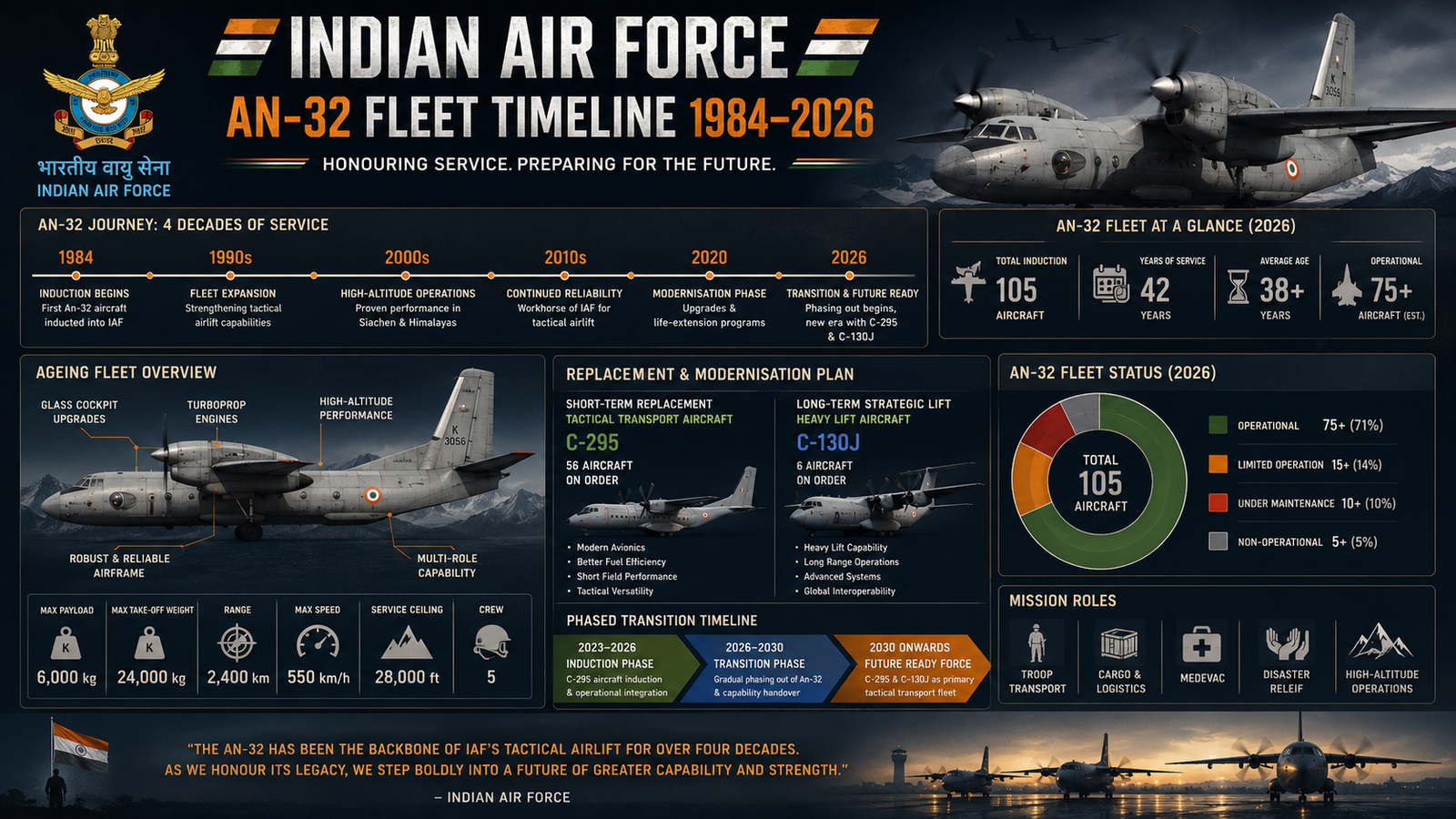
| Historical Context | An-32 fleet inducted between 1984-1991; over 40 years old; recognized as the backbone of tactical airlift in the Northeast |
The devastating IAF An-32 crash Jorhat tragedy reignites urgent, critical questions regarding the operational safety and longevity of the IAF’s ageing transport fleet. While the An-32 has reliably served as the backbone of tactical airlift for over four decades, this incident marks yet another tragic chapter in its expanding accident history:
1. Fleet Age Crisis: The An-32 airframes are currently over 40 years old, having been procured between 1984 and 1991. Despite necessary mid-life upgrades, structural fatigue remains a severe vulnerability in high-stress, high-altitude operational environments.
2. Northeast Operational Challenge: The Eastern Air Command operates in some of the world’s most demanding terrain. The Brahmaputra Valley features unpredictable microclimates, sudden wind shears, and visual flight rule limitations that collectively create a perfect storm for landing accidents.
3. Modernization Imperative: The IAF is actively, but gradually, inducting C-130J Super Hercules and EADS-CASA C-295 aircraft to replace the ageing An-32 fleet. The pace of this replacement must be aggressively accelerated to prevent further loss of life.
4. March 2026 Precedent: Alarmingly, just three months prior, a Sukhoi Su-30MKI crashed in Karbi Anglong immediately after taking off from this very same Jorhat Air Force Station, raising urgent questions regarding base-specific operational protocols and environmental factors.
Defencera Final Strategic Take: The tragic loss of five brave air warriors in the IAF An-32 crash Jorhat serves as a painful reminder that technological modernization in the armed forces is not merely about capability enhancement—it is fundamentally about saving lives. The timeline for replacing the IAF’s legacy transport fleet must now be treated as an acute national security emergency. For future defence leaders and exam aspirants, analyzing the intersection of ageing hardware, treacherous terrain, and high operational tempo is essential for understanding India’s evolving airpower strategy.
This incident is highly relevant across multiple layers of competitive examination syllabi. Here is how examiners might test this current event:
Security Challenges and their Management in Border Areas, Modernization of Armed Forces, Defence Procurement Policies, and the strategic role of the Cabinet Committee on Security (CCS) during national emergencies.
Policies affecting National Security, the structural hierarchy of the Indian Air Force, Operational Commands mapping, and the specific legal mandate of military Courts of Inquiry under the Air Force Act, 1950.
Aircraft specifications (An-32 vs modern C-130J/C-295 variants), identifying IAF operational commands (Eastern Air Command jurisdiction), and drafting essays on military defence procurement and border infrastructure.
Direct factual GK questions: “Which aircraft crashed in Assam recently?” (An-32RE), “Where did the crash occur?” (Jorhat-Rowriah), or identifying the active Air Command handling the Northeast region.
Do not settle for generic current affairs. Gain access to deep, structured breakdowns and defence intelligence updates designed to give you an analytical edge in your examinations.